

A garage door that suddenly stops closing, starts shaking, develops a damaged panel, or makes an unfamiliar noise can leave you with an immediate decision: should you repair the problem or replace the garage door altogether?
The obvious answer is often to repair whatever broke. That can make perfect sense when the problem is limited to one component and the rest of the door is still in good condition. But a repair becomes harder to justify when several parts are wearing out, the door has structural damage, replacement sections are no longer available, or you have already paid to fix similar problems more than once.
Making the wrong call can mean replacing an otherwise serviceable door unnecessarily or continuing to spend money on repairs without addressing a system that is nearing the end of its useful condition. In South Florida, storm damage and current wind-protection requirements can add another layer to that decision.
If you are trying to decide whether to repair or replace a garage door, look beyond the part that failed today. The condition of the entire system, the extent of the damage, repair history, available parts, safety, and what you need from the door going forward can all change which option gives you better value.
Start With How Much of the Garage Door Is Actually Damaged
One broken component does not automatically mean the entire garage door is failing. At the same time, the most visible problem may not be the only one.
A proper inspection should determine whether the issue is isolated or whether it has started affecting other parts of the system.
A Localized Problem Often Makes Repair More Practical
Many common garage door problems can be repaired without replacing the door itself.
That may include:
- A broken spring
- A damaged cable
- Worn rollers or hinges
- Track alignment problems
- A malfunctioning opener
- Damaged weather seals
- Sensor problems
- One damaged garage door section
Rocket Garage Doors repairs springs, cables, tracks, openers, rollers, hinges, panels, and other components, and its repair process includes checking the full system rather than assuming the most obvious symptom is the only issue.
If one component has failed while the door panels, tracks, hardware, and overall structure remain in good condition, repairing that component can restore normal operation without the expense of replacing the complete door.
Damage Across Several Parts Changes the Calculation
The decision becomes less straightforward when a damaged panel is accompanied by bent tracks, deteriorating hardware, corrosion, poor balance, or other problems.
At that point, repairing individual components one after another can become a temporary solution rather than a long-term fix.
The important question is no longer, “Can this part be repaired?” It is, “What condition will the entire door be in after the repair is completed?”
A repair may technically be possible while still being a poor use of money if several other components are likely to require work soon afterward.
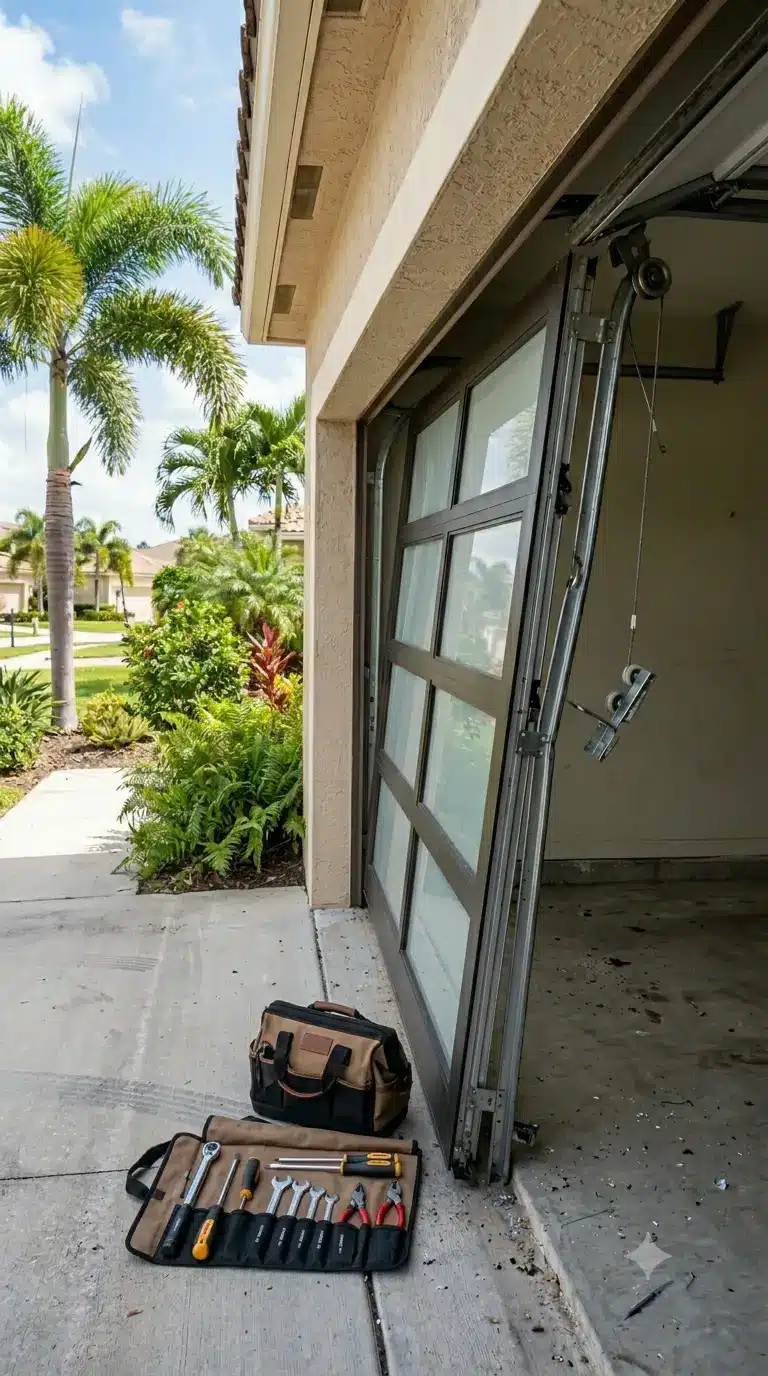
Can You Replace One Damaged Garage Door Panel?
Panel damage is one of the situations where homeowners frequently assume the whole garage door needs to go. In many cases, it does not.
Sectional garage doors are designed with individual sections, which can sometimes allow one damaged panel to be replaced while the rest of the door remains in place. Amarr notes that individual section replacement can make sense when damage is limited, while more extensive damage can make full replacement more practical.
Several details determine whether that option actually works.
The Replacement Panel Has to Be Available
The door manufacturer, model, dimensions, design, and section position all matter when ordering a replacement.
Older doors can create problems because the original model, panel design, color, or size may have been discontinued. Clopay notes that finding an exact replacement section can become more difficult with older or discontinued garage doors.
A technically repairable door may therefore become a replacement candidate simply because compatible components are no longer available.
A New Panel May Not Look Exactly Like the Old Ones
South Florida sun and weather can change a garage door finish over time.
Even when the correct replacement panel is available, a newly manufactured section may look different beside panels that have been exposed to years of sunlight and weather. Both Clopay and Amarr caution that color matching can be difficult on older doors because existing sections may have faded.
If appearance matters, compare the cost and finished result of replacing individual sections with the cost of replacing the complete door.
When Does Garage Door Replacement Make More Sense?
There is no universal age, repair price, or number of problems that automatically means a garage door must be replaced.
Replacement becomes more reasonable when several factors begin pointing in the same direction.
The Door Has Widespread or Structural Damage
One dent is different from several damaged sections.
If an impact has affected multiple panels, tracks, supporting hardware, or the way the door moves through the opening, replacing isolated pieces may not restore the system to the condition you want.
Amarr recommends considering the overall extent of damage when comparing section replacement with a complete new door, particularly when several sections or mechanical components are affected.
Storm damage deserves particular attention because what looks like cosmetic panel damage may be accompanied by problems with alignment, tracks, reinforcement, or attachment points.
Repairs Are Becoming a Pattern
A broken spring on an otherwise reliable garage door is one situation.
A door that has recently needed springs, rollers, track work, panel repairs, and repeated adjustments presents a different financial decision.
Keep track of what you have already spent and what is likely to need attention next. If each repair restores operation only until another aging component fails, replacement may offer better long-term value than continuing to service the door one problem at a time.
That does not mean an older door should automatically be replaced. A well-maintained older system may still be repairable. Repair history and overall condition are more useful than age alone.
The Existing Door No Longer Meets What You Need
Sometimes replacement is not driven by a complete mechanical failure.
Your existing garage door may still operate but no longer provide the features you want, such as:
- Better insulation
- Improved exterior appearance
- Quieter operation
- Updated glazing
- Better sealing
- A different material or style
- A hurricane-rated or impact-ready configuration
In those situations, continuing to repair the existing system may preserve a door you were already planning to upgrade.
Compare the Repair Cost With What the Repair Actually Buys You
Homeowners sometimes look for a simple percentage rule, such as replacing a garage door whenever the repair costs a certain portion of a new one.
That can be misleading.
A $500 repair that restores a door in otherwise excellent condition can make far more sense than a less expensive repair on a badly deteriorated system that will need several additional repairs shortly afterward.
Instead, compare:
- The immediate repair cost
- The overall condition of the door
- Other worn components likely to need service
- Availability of replacement parts
- How long you expect to remain in the home
- Features you would gain with replacement
- Whether the current door meets your storm-protection needs
- Installation and permitting requirements for a new door
The goal is not simply to choose the cheaper invoice today. It is to understand what condition you will have after paying it.
South Florida Storm Damage Can Change the Repair-or-Replace Decision
A garage door in South Florida has another job beyond everyday access. Depending on the property and location, it may also form part of the building envelope that has to meet specific wind and impact requirements.
That makes storm-related damage different from a minor cosmetic dent.
Do Not Assume a Damaged Hurricane Door Can Be Modified Freely
A hurricane-rated or impact-resistant garage door receives its rating as a tested and approved assembly. Panels, reinforcement, tracks, hardware, anchors, glazing, dimensions, and installation details can all be part of that approved configuration.
That means repairs or modifications to a storm-rated door should preserve the requirements of the applicable product and installation rather than simply making the door look functional again.
If significant storm damage has occurred, the exact door and approval should be reviewed before deciding how it can be repaired.
A Full Replacement May Trigger Permitting and Product Approval Requirements
Garage door replacement in Miami-Dade County requires a stand-alone permit application along with the proposed door size and applicable Miami-Dade or Florida product approval information. The county also requires the current applicable Notice of Acceptance for the garage door used.
Requirements vary by jurisdiction, so homeowners elsewhere in South Florida should confirm the rules with the building department responsible for their property.
This is another reason repair and replacement are not always interchangeable decisions. Replacing the complete door can involve product selection, wind requirements, measurements, approvals, and permitting that are not part of a minor mechanical repair.
Make Sure the Garage Door Is the Problem Before Replacing It
A garage door that will not open does not necessarily need a new garage door.
Sometimes the opener has failed. In other cases, the problem may be a spring, cable, sensor, roller, track, or balance issue.
For example, a broken spring can make the door feel extremely heavy and may cause an opener to struggle. Replacing the opener would not solve the underlying problem.
Rocket Garage Doors checks components such as the opener, panels, tracks, hardware, movement, and closure before recommending repair or replacement.
A complete diagnosis gives you a much better basis for deciding where your money should go.
Some Garage Door Repairs Should Not Be DIY Projects
There are useful things homeowners can inspect themselves, including visible panel damage, unusual noises, damaged weather seals, or changes in how the door moves.
Springs and cables are different.
Garage door spring systems operate under high tension. Overhead Door warns homeowners not to attempt repairs to springs or cables because improper handling can cause serious injury, and DASMA similarly recommends that high-tension spring and cable work be handled by trained technicians.
If the door has a broken spring, frayed cable, severe imbalance, damaged bottom bracket, or other problem involving the counterbalance system, stop using it until the system can be properly evaluated.
Repair the Door When It Makes Sense, Replace It When It Solves More
The right decision is rarely based on one symptom.
Repair often makes sense when the problem is isolated, compatible parts are available, the door is structurally sound, and fixing the issue leaves you with a system you can reasonably continue using.
Replacement becomes more compelling when damage is widespread, parts are unavailable, repairs keep accumulating, the door no longer meets your needs, or restoring it would mean investing heavily in a system with several other problems.
Rocket Garage Doors provides garage door repair and replacement services throughout Broward, Miami-Dade, and Palm Beach Counties. Rather than assuming every damaged door needs replacement, the team inspects the door, opener, panels, tracks, hardware, and movement before explaining what needs to be repaired, adjusted, or replaced.
If you are unsure whether another repair makes sense, contact Rocket Garage Doors to have the complete system checked before deciding what to replace.
Frequently Asked Questions About Garage Door Repair or Replacement
Is it better to repair or replace a garage door?
Repair usually makes sense when the problem is isolated and the rest of the door remains in good condition. Replacement becomes more reasonable when damage is extensive, repairs are becoming frequent, compatible parts are unavailable, or you want significant performance or storm-protection upgrades.
How do I know if my garage door is beyond repair?
Look at the complete system rather than one broken part. Multiple damaged panels, structural problems, severe corrosion, recurring failures, unavailable replacement components, or extensive storm damage can make replacement more practical.
Can one garage door panel be replaced?
Often, yes. Sectional garage doors may allow a damaged section to be replaced individually if the appropriate panel is still available and the rest of the door is in good condition.
Is it worth replacing two or more damaged garage door panels?
It depends on the door, parts availability, labor, overall condition, and replacement cost. As the number of damaged sections increases, compare the total panel-repair cost with complete replacement rather than assuming individual panels remain the better value.
Should I replace an old garage door even if it still works?
Not solely because of age. Consider its condition, reliability, repair history, parts availability, safety, appearance, insulation, and storm performance. An older door that remains in good condition may still be serviceable.
Can a broken garage door spring be repaired without replacing the door?
Yes. A broken spring does not normally mean the complete garage door must be replaced if the rest of the system is in suitable condition. Spring work should be performed by a trained technician because the counterbalance system operates under high tension.
Does a broken opener mean I need a new garage door?
No. The opener and garage door are separate parts of the system. An opener may sometimes be repaired or replaced while keeping the existing door, provided the door itself is properly balanced and in good condition.
Should I replace a garage door after hurricane damage?
It depends on the extent of the damage and the approved configuration of the existing door. Minor repairable damage and major structural damage should not be treated the same way. Have a storm-rated door evaluated before changing panels, reinforcement, tracks, or other components that may affect its approved configuration.
Does replacing a garage door require a permit in South Florida?
Requirements depend on the jurisdiction. Miami-Dade County requires permitting and product approval documentation for garage door replacement. Homeowners in other municipalities should verify requirements with their local building department.
Can I repair garage door springs or cables myself?
These are not recommended DIY repairs. Springs, cables, bottom brackets, and related components can be under substantial tension and can cause serious injury if handled incorrectly.
What should a garage door technician inspect before recommending replacement?
The inspection should consider more than the visible damage. Relevant components can include panels, springs, cables, rollers, tracks, hinges, balance, opener operation, sensors, hardware, seals, closure, and the condition of the opening.
Should I repair my garage door if I plan to replace it soon?
That depends on the problem. A necessary safety or access repair may still be appropriate in the short term, but investing heavily in cosmetic or extensive repairs may make less sense if a full replacement is already planned. Ask for both options when the costs are close enough that the decision is not obvious.